Shipungu, community school Zambia

rammed earth now has a national standard in 15 African countries


The road to building this community school in Zambia is a long one. Zambia inherited a building code from the British which was not changed in the independence era. This means that buildings like schools, built and run by government must follow British norms, so be built from concrete and brick.

Unless a school conforms to national norms it will not qualify for government teaching staff. Without a government teacher children are not able to take exams. Without exams children cannot progress to secondary school. This story is repeated across post colonial Africa, where technical standards control the means to learning of millions.

So to build this school first there had to be a national standard for rammed earth. We worked for some years writing a national standard for Zimbabwe, and then worked to get Zimbabwe's trading partners, the 15 country SADC group, to harmonise the Zimbabwe standard. It only took another 5 years!

Once that was done BuildIT agreed to build the first rammed earth school in Zambia. Build IT are an organisation we had been talking to for some time and who build schools in Zambia, so they were ideally placed to help.

The community had already built a school using mud bricks, a material which has no national standard and so cannot be used to


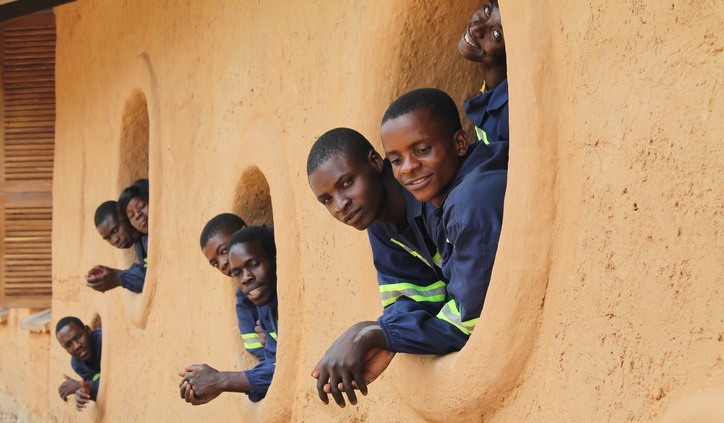
  The workforce were all drawn from the local community, turning elements on site into buildings  
     

build schools. They had been running classes for a few years, but with no hope of getting their pupils into local secondary education when the offer came from Build IT to build in rammed earth.

The offer involves taking local unemployed youth and giving them training in a range of skills. In return the trainees give their labour at a rate which covers their costs. On this site the first job was digging foundations and a pit with more clayey material. The foundation material and the clay material were mixed to build walls, adding water from the well for the right moisture content.

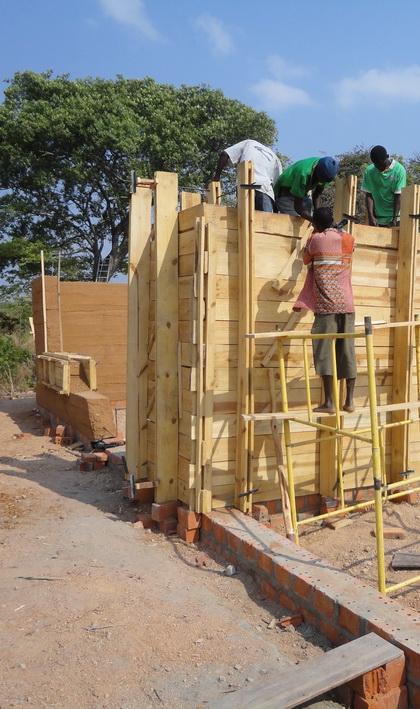
A very simple set of timber working tools were brought to site and two sets of formwork were built over three days. Simple tools can build effective rammed earth tools and formwork quite quickly.

We used three different types of formwork, a simple moving set, a hybrid static timber set and a hired steel set. The moving formwork had no end stops but rather joined wall elements with a sloping end detail. This was used in two main ways, to fill side walls between the big gable end sections and to make the higher sloping elements of the gable ends. Strangely this set was the most challenging to use for the team when working on their own.
The hybrid set consisted of vertical 'soldier', elements bolted top and bottom and boards slid in place as the rammed earth work proceeded. There were teething problems with this set in part due to the variable sizes of timber supplied, but these were soon ironed out.
Finally we used commercially available concrete formwork to form curved wall elements. This was considered to be an inexpensive option but of course when hiring formwork all depends on how long they are on hire for and for how long. For this reason timber which is bought can have the cost spread over a number of different projects lowering the total considerably.

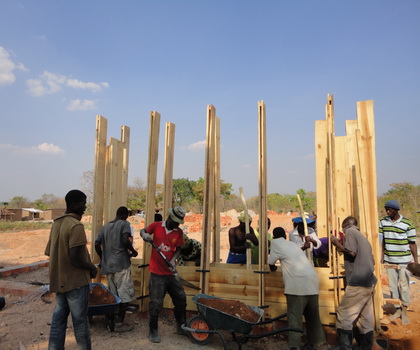
After a few days of preparing formwork the first large  corner set was assembled. Material was mixed and placed onto a damp proof course at the bottom of the formwork, and ramming began. The trainees had a fantastic work rate, producing 12 square metres of wall in a day and a half, having never built with rammed earth before.

As the work progressed on the first section the team assembled the start of the second corner formwork assembly. As soon as 


    Formwork skills were shared  


the first corner was complete the second was begun. In this way the flow of work was constant. We had planned for the first two gable ends to be built consecutively and for the roof to be put up as the third gable end was being built so that the building was weather tight as it went along. However due to supply issues this was not achieved and the more normal wall building followed by roof was what actually happened.

The school was finished with a natural earth plasters and paints as a bit of lime wash too. All the big elements of the walls and finishes were found and used on site, one of the reasons the price for the whole school was 15% to 20% less than Build ITs regular classroom costs, already low by local standards. Driving down costs has to be a priority, different approaches to foundations, to floors, to openings will all play their part, as will reducing and replacing the need for foreign consultants!


    Once the formwork was erected the tram produced 12m2 wall in a day and a half  


Articles