|
one group and ensure it was said to the next.
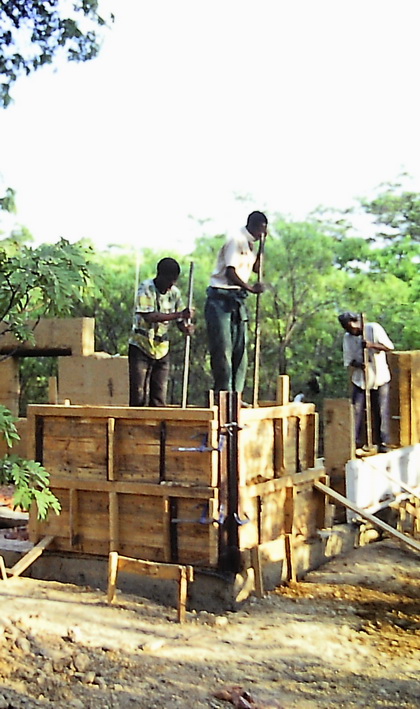
There were some nice elements to the build. We had
prepared two sets of formwork, one from bought plywood and timber, the
other from packing cases for importing sheet glass. The ply had to be
fixed with bought screws, the packing cases came with their own nails
and coach bolts, carefully recovered while dismantling the boxes. Both
sets did the same thing, that is could join onto the set below, make
corner pieces and build up vertically.
The lintels over windows and doors were made from the
off-cuts of roof poles, two side by side and one smaller one on top to
fill the gap between the two below. The poles were bedded down on soft
material before ramming and behaved very well. One spine wall
internally was rammed earth, all the other dividing walls were made
from the centres block making project, thinner and non load bearing.
The building followed our publication Rammed Earth
Structures a Code of Practice while it was still in preparation as the
Zimbabwe National Standard on Rammed Earth Structures, later the
SADC harmonised code covering 15 countries, 460m people. Foundations
included lime burnt in the process of producing iron and steel, a
great product under used and therefore about a quarter of the price at
that time of cement. Cheaper still because cement products typically
start at around 7% cement content while for soil stabilisation 7% is
the upper limit. Still we only used it for the foundations with a damp
proof course between that and the unstabilised walls above.
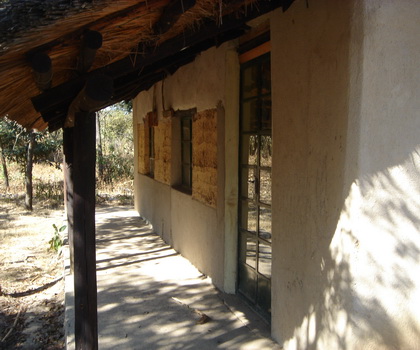
Fambidzanai had its own in house building team which
could handle a range of different materials and structures. They
assembled the roof structure and thatched it and then finished the
building after placing ground and first floors.
|