|
Building corners with rammed earth can be done in two ways,
either like large building blocks, with a moving formwork
approx. 2m long x .7m high making a bonded corner, or with a
fixed formwork built into a corner shape. A purpose built
corner formwork can be made in many different ways, there is
no 'right' way, just what is affordable and available.
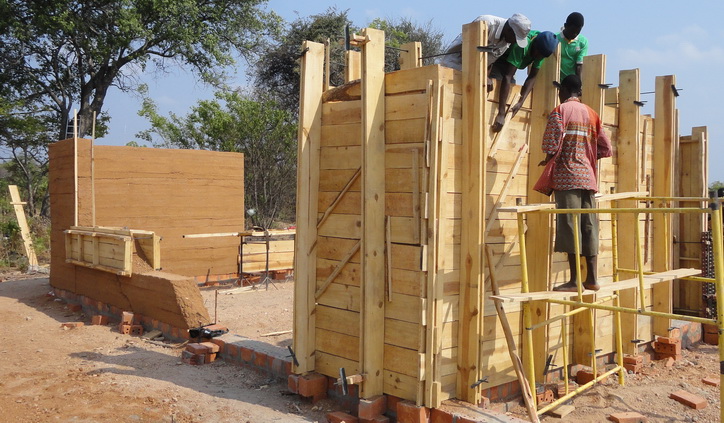
The example
shown at the top is a hybrid fixed formwork made from standard
board sizes in Zambia. The vertical ribs or soldiers contain
the horizontal planks using steel re-bar with a
threaded bar welded on one end. Other ways to hold the
soldiers include wedge clamps, tourniquet ropes and slotted
bolts.
A corner is
much like a straight section of wall in material terms but may
have different stresses placed on it, perhaps from the
building design or from seismic action. So corners may then be
reinforced with mesh or timber rammed in at several heights.
The top of the corner is typically reinforced with a roof
plate tied down into the wall using bolts or straps.
Assuming the
walls are not under any extraordinary loads they are then
built as all rammed earth, with successive layers of soil
rammed into the formwork which in this case happens to be
corner shaped. Using a fixed form in this way means more time
setting up the first 'lift', say 0.7m height, but very rapid
assembly of later lifts guided by full height soldiers. As
with all formwork use it becomes easier with use and
experience and time taken in the making of the formwork will
pay dividends as the work progresses.
This is a
hybrid system since it is made from loose boards but makes up
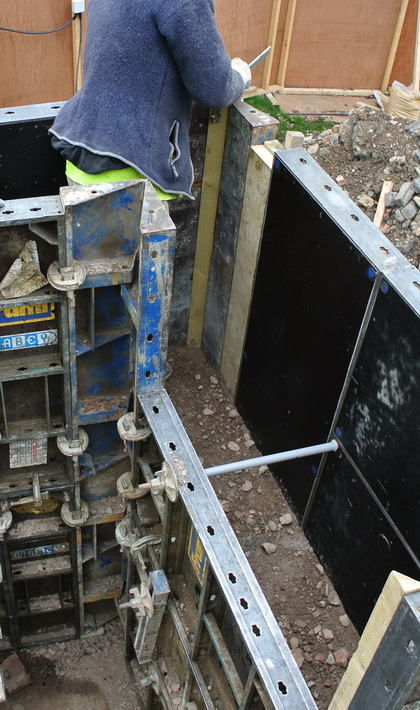
a large section of formwork and wall. Often commercial
formwork like the middle image is used. This is made from separate large panels
typically ply faced with steel frames. Separate corner pieces
are used to make inside and outside corners, clamping to the standard
panels in a variety of ways. Newer systems are being
developed made from plastics but these have not been tested
with rammers so far.
All systems, moving, fixed or hybrid benefit from the
use of chamfers on the external corners, sofetning the formed edge and
making it more robust against both mechanical and weather abrasion.
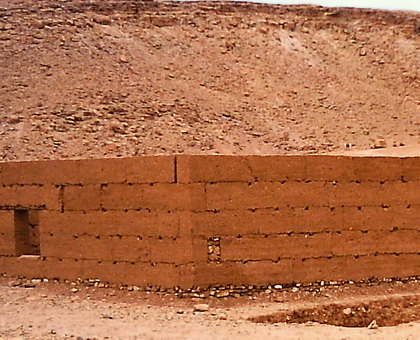
The final example is built using moving formwork and
the bonding of the blocks is clear to see. Both the hard corner edge
and the large bolt holes will likely be finished with a clay plaster.
|